Marketing & Sales | 11 min read
Published
AI Answer Engine Optimization for Small Business: How to Show Up in Google AI Answers
Use this plain-English checklist to make your website, service pages, FAQs, and local business profile easier for AI answers to understand and cite.
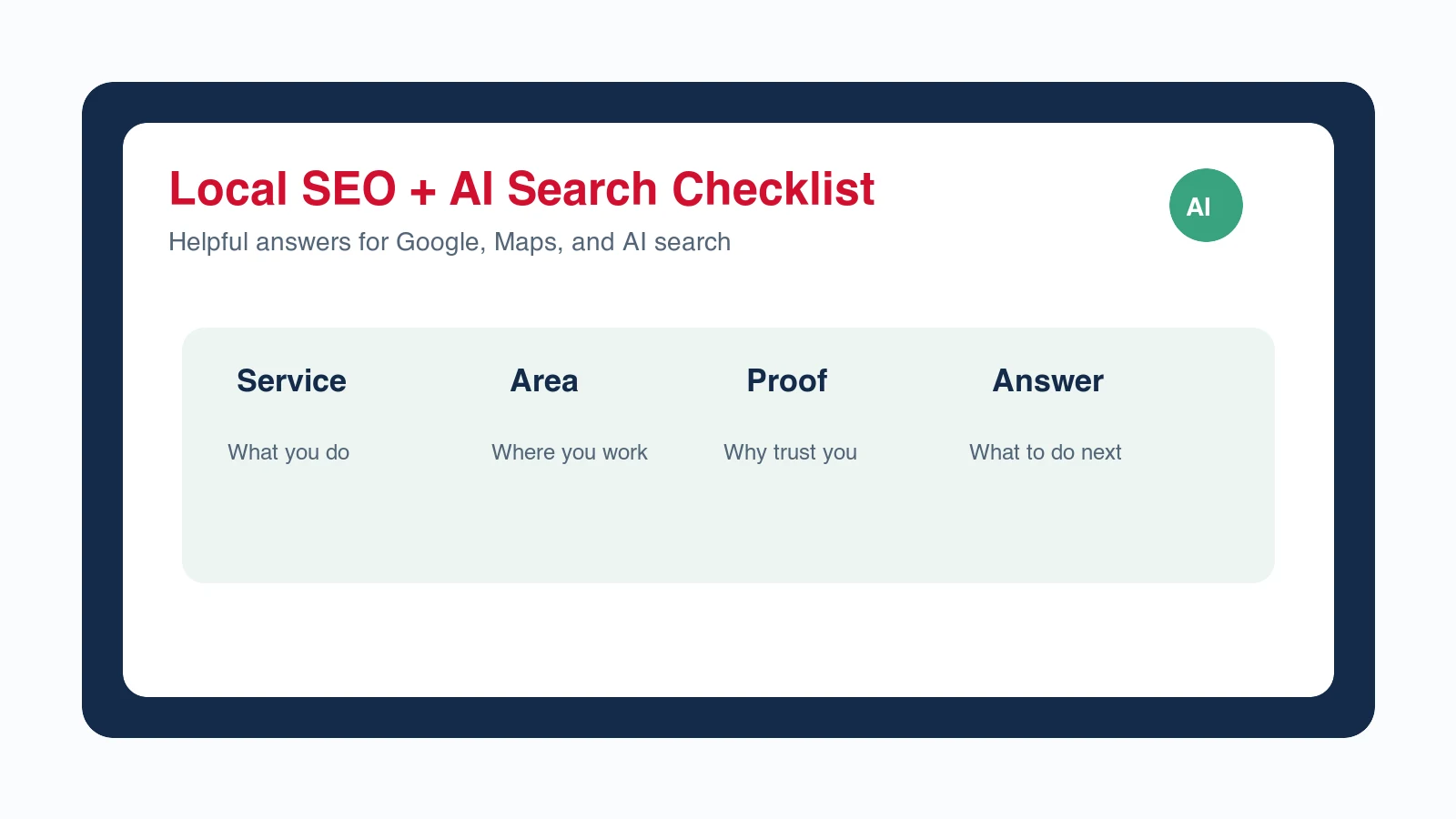
AI answer engine optimization for small business means making your website, service pages, local business information, FAQs, and proof easy for Google Search, AI answers, and customers to understand. For local business owners, B2B and online business owners, employees, and managers, the practical goal is simple: publish clear answers about who you help, what you do, where you serve, why customers trust you, and what someone should do next.
What is AI answer engine optimization?
AI answer engine optimization, often shortened to AEO, is the practice of structuring your content so search engines and AI answer systems can extract a direct, accurate answer from it. Generative engine optimization, or GEO, is a similar phrase people use for improving visibility in AI-generated search experiences.
The plain-English version is this: stop hiding your best answers inside vague marketing copy. Put the answer near the top, make the page specific to one customer intent, support the claim with proof, and give the next step clearly.
Does SEO still matter for Google AI answers?
Yes. Google Search Central says its generative AI features in Search are rooted in core Search ranking and quality systems. That means small businesses should not abandon SEO fundamentals for a new acronym. Clear pages, crawlable content, useful answers, accurate titles, strong snippets, and trustworthy information still matter.
This is good news for owners and managers. You do not need a new gimmick every time search changes. You need better pages that answer the questions customers already ask before they call, book, request a quote, or compare options.
What should a small business optimize first for AI search?
A small business should optimize the pages and profiles closest to revenue first: homepage, service pages, location pages, Google Business Profile, review responses, FAQs, and high-intent comparison pages. These are the places where answer systems and customers look for facts.
- Clarify the page purpose in the title, headline, opening paragraph, and main service explanation.
- Answer the buyer question directly before adding background or persuasion.
- Name the service, audience, location or service area, proof, pricing constraints, and next step where relevant.
- Add FAQ-style sections for questions customers ask on calls, forms, reviews, and sales conversations.
- Use structured data where it accurately describes the page and matches Google Search documentation.
- Keep business profile information current, especially hours, contact details, services, photos, and review activity.
How do local businesses show up in AI answers and local results?
Local businesses improve AI answer visibility by making local facts consistent and easy to verify. A dentist, roofer, med spa, restaurant, salon, contractor, gym, or professional service business should make the service area, hours, phone number, address, appointment path, photos, services, reviews, and common customer questions obvious.
Google Business Profile help specifically encourages verified businesses to keep details such as address, hours, contact information, and photos accurate and up to date. That matters because local customers often decide quickly, and inconsistent facts create friction before a human ever calls.
What a local service page example looks like
A local HVAC company should not publish a page that only says it offers great service. A stronger page answers: Do you repair air conditioners near me? Which cities do you serve? Do you offer emergency appointments? What brands do you work on? How fast can someone request help? What should a homeowner check before calling? What proof shows you are trustworthy?
A checklist for local managers to work through
- Check that the website and Google Business Profile use the same business name, service categories, phone number, address, and hours.
- Add real service descriptions that match how customers search, not internal jargon.
- Turn repeated phone questions into FAQ sections on the most relevant service page.
- Use recent photos that show the team, work, location, products, or customer experience.
- Reply to reviews with specific, human language that reinforces services and customer care.
How do B2B and online businesses optimize for AI answers?
B2B and online businesses should focus on buyer education, comparison clarity, proof, process, and next-step pages. AI answers are often triggered by research questions: best way to solve a problem, what a service includes, how two options compare, what a buyer should ask before choosing, or how a workflow works.
- Create one page per major buyer problem instead of blending every offer into one general page.
- Add short definitions near the top for terms your buyers search but may not fully understand.
- Publish comparison sections that explain who each option is for and when it is a bad fit.
- Include proof such as outcomes, examples, process steps, credentials, customer language, or implementation detail.
- Make demo, consultation, purchase, or seminar next steps obvious without forcing the reader to hunt.
What page structure helps AI systems extract the answer?
Answer-ready pages use a predictable structure: a direct answer, short supporting explanation, proof, examples, steps, objections, FAQs, and a clear call to action. This helps human readers scan and helps search systems understand the page topic without guessing.
- Start with a direct answer in the first paragraph.
- Use H2 headings that match real customer questions.
- Use H3 headings for examples, roles, locations, services, or decision factors.
- Put checklists and steps in lists so they are easy to extract.
- Keep each page focused on one search intent instead of trying to answer every possible query.
- Add a final next step that matches the page intent, such as calling, booking, requesting a quote, or finding a seminar.
What structured data should small businesses understand?
Structured data is code that helps Google understand page content and the entities on the page. Google Search Central explains that structured data can help Google understand content and gather information about people, organizations, products, recipes, and other entities when the markup is accurate.
Small businesses do not need to memorize every schema type. They should make sure their website platform or developer handles accurate Organization, LocalBusiness, Article, Product, Service, Breadcrumb, FAQ, or Event markup when it truly fits the page. The markup should describe the real content on the page, not invent facts.
What can employees and managers do this week?
Employees and managers can improve AI search readiness without waiting for a full redesign. The fastest useful work is collecting the answers customers already ask for and turning them into clear, reviewable website content.
- Export or summarize the last 25 customer questions from calls, forms, chats, emails, reviews, and sales conversations.
- Group questions by service, location, objection, price concern, timing concern, and trust concern.
- Draft one direct answer for each question in plain English.
- Ask a manager or owner to verify accuracy, claims, prices, policies, and risk-sensitive language.
- Add approved answers to the most relevant page instead of creating one giant FAQ page nobody visits.
How Winning With AI teaches answer-ready workflows live
Winning With AI is a live AI seminar for business owners, employees, and managers who want to turn business knowledge into practical output. For answer engine optimization, that means learning how to use AI to organize customer questions, draft clearer pages, create FAQs, improve follow-up, and build content that sounds like the business instead of a generic tool.
The live format helps because most owners and teams already know the answers. They just have not converted those answers into pages, prompts, checklists, review responses, and workflows that search systems and customers can understand. WinningWithAI.com helps local, B2B, and online teams find a practical AI seminar near them.
AI answer engine optimization FAQ
Is AEO different from SEO?
AEO is best understood as a sharper version of SEO focused on direct answers, clear structure, and extractable information. Google guidance says SEO fundamentals still matter for generative AI search experiences, so small businesses should improve clarity instead of chasing shortcuts.
Can AI write my small business FAQ pages?
AI can draft FAQ answers, but the business should provide real customer questions, accurate service details, local context, proof, and a human review step. AI should not invent policies, prices, guarantees, legal claims, medical guidance, or financial promises.
What is the best first page to optimize for AI answers?
The best first page is usually the service, offer, or location page that already gets qualified traffic or sales questions. Improve that page before publishing more thin content.
Where can I learn AI search workflows for business live?
Winning With AI teaches practical AI workflows for owners, employees, and managers in a live seminar format. Visit WinningWithAI.com to find a local seminar and see how AI can help turn customer questions into useful business content.
Keep answer-ready publishing consistent with an AI content calendar for a small business and use customer language in referral and reactivation campaigns. The Winning With AI productivity guide offers another plain-English resource for practical AI adoption.
Find a Winning With AI Seminar Near You
How long does it take to show up in AI answers?
Longer than a ranking change and shorter than a reputation. AI systems pull from pages they have already crawled and from sources that mention you elsewhere, so a rewritten page helps once it is recrawled, and external mentions accumulate over months. Treat it as compounding work rather than a switch you flip.
Do I need schema markup to be quoted by AI?
It helps and it is not the deciding factor. Schema tells a parser what a page is and which text answers which question, which makes extraction reliable. What decides whether you get quoted is having a clear, self-contained answer near the top of a page that genuinely covers the question somebody asked.