Tools & Workflows | 10 min read
Published
AI Customer Feedback Analysis for Small Business: Turn Reviews, Calls, and Emails Into Better Decisions
A practical workflow for using AI to turn reviews, calls, support messages, surveys, and sales notes into better decisions without losing human judgment.
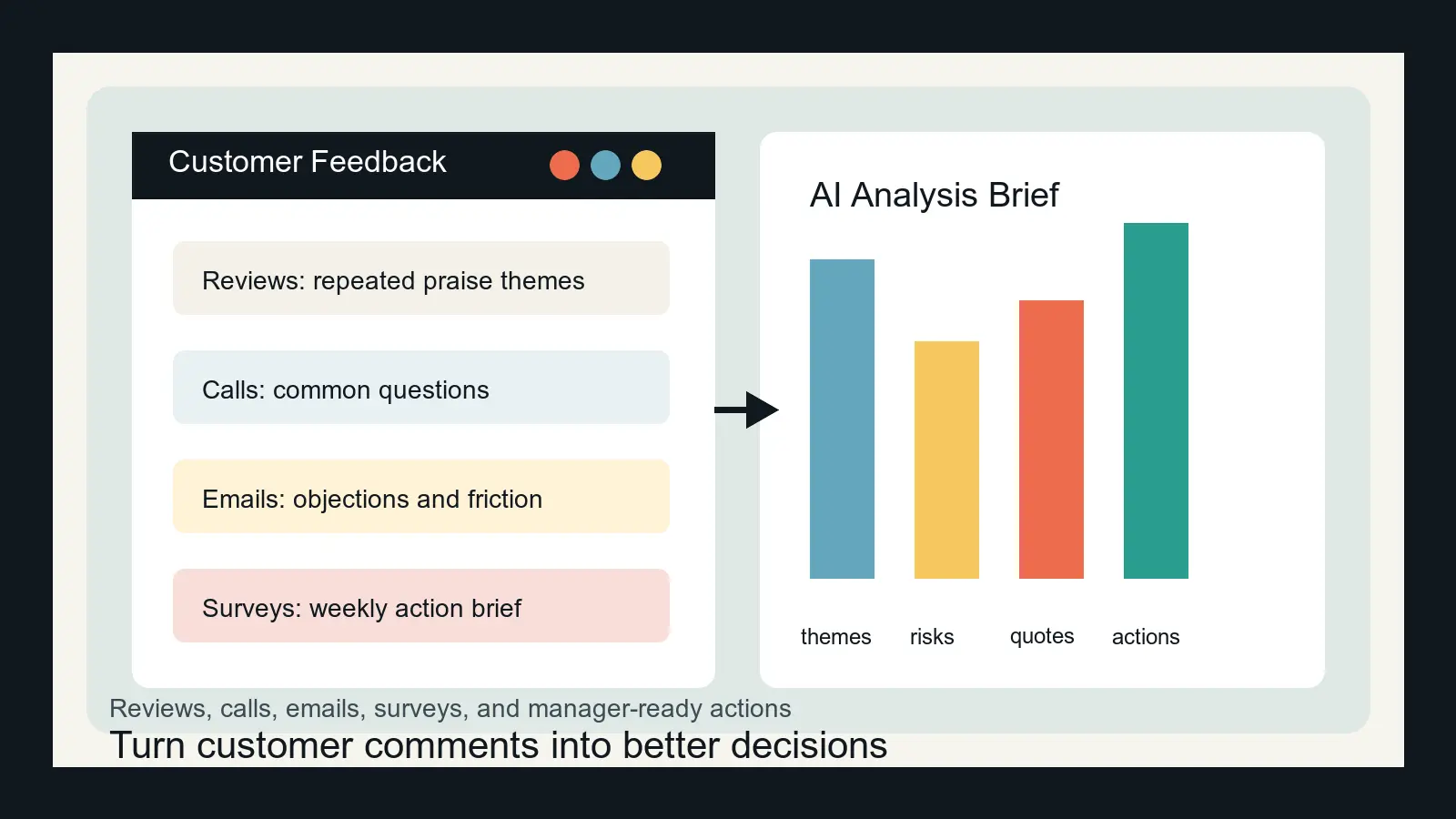
AI customer feedback analysis is the use of artificial intelligence to summarize reviews, calls, emails, chats, surveys, social comments, and sales notes so a small business can see what customers keep asking, praising, complaining about, misunderstanding, and buying for. For local business owners, B2B and online owners, employees, and managers, the value is not a fancy dashboard. The value is a clearer weekly decision: what should we fix, explain, promote, train, or follow up on next?
When those reviews, survey answers, and service notes already live in rows and columns, use the AI spreadsheet analysis workflow for small business to clean the working copy, define the categories, reconcile the row count, and keep each conclusion tied to its source records.
What is AI customer feedback analysis?
AI customer feedback analysis is a plain-English workflow for turning raw customer input into a short business brief. Instead of reading twenty reviews, six call notes, eleven emails, and a survey export one by one, a manager can ask AI to group the comments by theme, sentiment, product or service issue, objection, urgency, and recommended next step.
The U.S. Small Business Administration says AI can help small businesses do more with less, improve internal efficiencies, and test tools carefully before committing. Customer feedback is a strong place to start because most businesses already have the raw material. They simply need a repeatable way to learn from it.
What customer feedback should a small business analyze with AI?
Start with feedback that is already part of normal business operations. Do not begin by buying a complex tool or exporting every system at once. Choose one source, one question, and one recurring decision the owner or manager needs to make.
What reviews and testimonials reveal
Reviews can reveal the words customers use when they are happy, confused, frustrated, surprised, or ready to recommend the business. AI can group positive proof points, common complaints, recurring service issues, staff mentions, location-specific concerns, and phrases worth reusing in ethical marketing copy.
Calls, chats, and support emails
Frontline conversations often contain the clearest truth. Customers ask the same questions, stumble on the same instructions, worry about the same price issues, or need the same reassurance. AI can summarize those patterns so employees and managers are not relying on memory alone.
Sales objections and lost-deal notes
For B2B and online businesses, feedback often appears inside sales calls, demo notes, proposal replies, webinar questions, trial cancellations, and abandoned checkout messages. AI can help separate true product fit problems from unclear messaging, missing proof, wrong timing, pricing confusion, or follow-up gaps.
Survey answers and employee observations
Survey answers are useful, but employees also hear the informal comments that never reach a spreadsheet. A weekly workflow can combine survey answers with front-desk notes, customer service themes, field team observations, and manager comments.
How can local businesses use AI to analyze reviews and calls?
A local business should use AI feedback analysis to improve customer experience, employee scripts, service pages, local offers, FAQs, and follow-up. The goal is not to automate empathy. The goal is to spot patterns fast enough to fix them before they quietly cost the business leads, repeat visits, referrals, and reviews.
- A dental office can find the questions new patients ask before booking and turn them into a better phone script and website FAQ.
- A home services company can identify the complaints that happen before, during, and after estimates so the owner knows which step needs a clearer process.
- A salon, med spa, gym, or clinic can group positive review language into service benefits, staff strengths, and customer outcomes.
- A restaurant or retail location can compare location-specific comments about wait time, service, ordering, parking, product availability, and repeat-customer requests.
- An employee can turn a week of messy customer notes into a one-page manager brief instead of forwarding scattered messages.
How can B2B and online businesses use AI customer feedback?
B2B and online businesses can use AI customer feedback analysis to improve offers, onboarding, sales pages, demos, support content, retention campaigns, product positioning, and renewal conversations. The best use is often finding the gap between what the company thinks it sells and what customers actually say they needed.
- Collect recent sales notes, support tickets, cancellation reasons, demo questions, customer success notes, survey answers, or webinar chat questions.
- Remove unnecessary sensitive data before pasting anything into an AI tool.
- Ask AI to group the comments by desired outcome, objection, friction point, missing proof, confusing feature, competitor comparison, and next action.
- Have a manager verify each theme against the original source material.
- Turn the top three verified themes into a landing page update, sales enablement note, onboarding improvement, or follow-up campaign.
What should an AI feedback brief include?
A good AI feedback brief should be short enough for an owner, manager, or team lead to use in a weekly meeting. If it turns into a long report nobody reads, the workflow is already too heavy.
- Source summary: which reviews, calls, emails, chats, surveys, or notes were included.
- Top praise themes: what customers repeatedly value, remember, or recommend.
- Top complaint themes: what customers repeatedly find confusing, slow, missing, risky, expensive, or frustrating.
- Customer language: exact phrases that can improve service scripts, FAQs, sales pages, emails, and ads after human review.
- Friction points: the step where customers hesitate, misunderstand, cancel, complain, or need reassurance.
- Evidence examples: a few representative comments so the theme does not become detached from reality.
- Recommended actions: three practical changes ranked by impact, effort, and owner approval needed.
What are the safest rules for using AI with customer feedback?
Customer feedback can contain personal information, health details, financial clues, employee names, private complaints, or confidential business context. NIST describes its AI Risk Management Framework as a voluntary resource for incorporating trustworthiness considerations into AI design, use, and evaluation. For a small business, that means deciding what information AI may see, what it may summarize, and who approves the final decision.
The Federal Trade Commission has also warned businesses about deceptive AI claims, unsupported performance promises, and privacy or confidentiality commitments. That matters here because AI should not invent testimonials, exaggerate customer outcomes, expose private information, or turn one complaint into a sweeping claim.
- Do not paste unnecessary personal, medical, financial, legal, employee, or confidential customer data into an AI tool.
- Do not let AI invent testimonials, star ratings, customer quotes, guarantees, savings, earnings, rankings, or outcomes.
- Do verify AI summaries against the original feedback before changing offers, training employees, or responding publicly.
- Do separate common patterns from one-off comments, especially when the decision affects pricing, staffing, policy, or service promises.
- Do ask qualified counsel before using AI in regulated, high-stakes, employment, medical, financial, housing, insurance, or automated decision workflows.
What is a practical AI customer feedback prompt?
Use this prompt as a starting point: Act as a customer experience analyst for a [business type]. Review the following customer feedback from [source]. Use only the information provided. Group the feedback into praise themes, complaint themes, confusion points, objections, repeated questions, exact customer phrases, and recommended actions. Flag any sensitive information, unsupported claims, or themes with too little evidence. Give me a one-page manager brief with the top three actions for this week.
How should employees and managers use the results?
Employees and managers should treat AI feedback analysis as a draft briefing tool. The person still owns the judgment. That is good news for employees who want to become more valuable: the skill is not merely using AI, but using AI to produce clearer work that helps the owner make better decisions.
- Check whether the AI used only the feedback it was given.
- Remove private details and unsupported conclusions.
- Highlight the three strongest recurring patterns.
- Attach representative examples for each pattern.
- Recommend one fix, one script improvement, one FAQ update, or one follow-up action.
- Ask the owner or manager what should become the new standard process.
How Winning With AI teaches customer feedback workflows live
Winning With AI is a live AI seminar for business owners, employees, and managers who want plain-English workflows they can actually use. Customer feedback analysis is a strong seminar example because it connects AI to real business decisions: better offers, better service, better replies, better training, better pages, and better follow-up.
At a Winning With AI seminar, the point is not to make AI sound magical. The point is to show how a local, B2B, or online business can brief AI, review the output, protect trust, and turn messy customer comments into a practical action plan. WinningWithAI.com helps owners and teams find a Winning With AI seminar near them and see these workflows demonstrated live.
AI customer feedback analysis FAQ
Can AI analyze customer reviews for a small business?
Yes. AI can summarize customer reviews, group repeated praise and complaints, identify common questions, and suggest practical next actions. A human should still verify the output and approve any public response or business change.
What is the best first feedback source to analyze?
The best first source is the one tied to a decision you already need to make. For many local businesses, that is recent Google reviews, phone notes, or support emails. For B2B and online businesses, it may be demo notes, sales objections, support tickets, or cancellation reasons.
Can employees use AI to summarize customer feedback?
Yes, if the business has clear rules for privacy, data handling, human review, and approved actions. Employees can become more valuable by turning scattered feedback into clean manager briefs, scripts, FAQs, and action checklists.
Where can I learn this customer feedback workflow live?
Winning With AI teaches practical AI workflows in a live seminar format for owners, employees, and managers. Visit WinningWithAI.com to find a local seminar and see how AI can help with customer feedback, reviews, service scripts, sales notes, and daily business decisions.
Feedback becomes actionable when it feeds an AI customer-retention workflow for small business and improves documents such as AI-assisted estimates and proposals. It can also strengthen sensitive processes such as AI invoice follow-up. Review the Winning With AI success stories for more examples of practical business outcomes.
Find a Winning With AI Seminar Near You
How much feedback do I need before AI analysis is useful?
Around thirty pieces is enough to see a pattern, and you almost certainly have that already across reviews, emails, and call notes. Below that, AI will still find themes, and you should treat them as questions to check rather than conclusions. The risk at small volumes is confidently summarising two loud customers.
Can I use AI on feedback that includes customer names?
Strip identifying details before the text goes in, which takes seconds and removes the whole question. The analysis you want is thematic anyway: what keeps coming up, in what proportion, and which parts of the job cause it. Nothing in that requires knowing which customer said what.