Marketing & Sales | 11 min read
Published
AI Lead Qualification for Small Business: Ask Better Questions Before You Quote or Sell
A practical AI lead qualification workflow for owners, employees, and managers who want cleaner sales conversations before sending a quote or proposal.
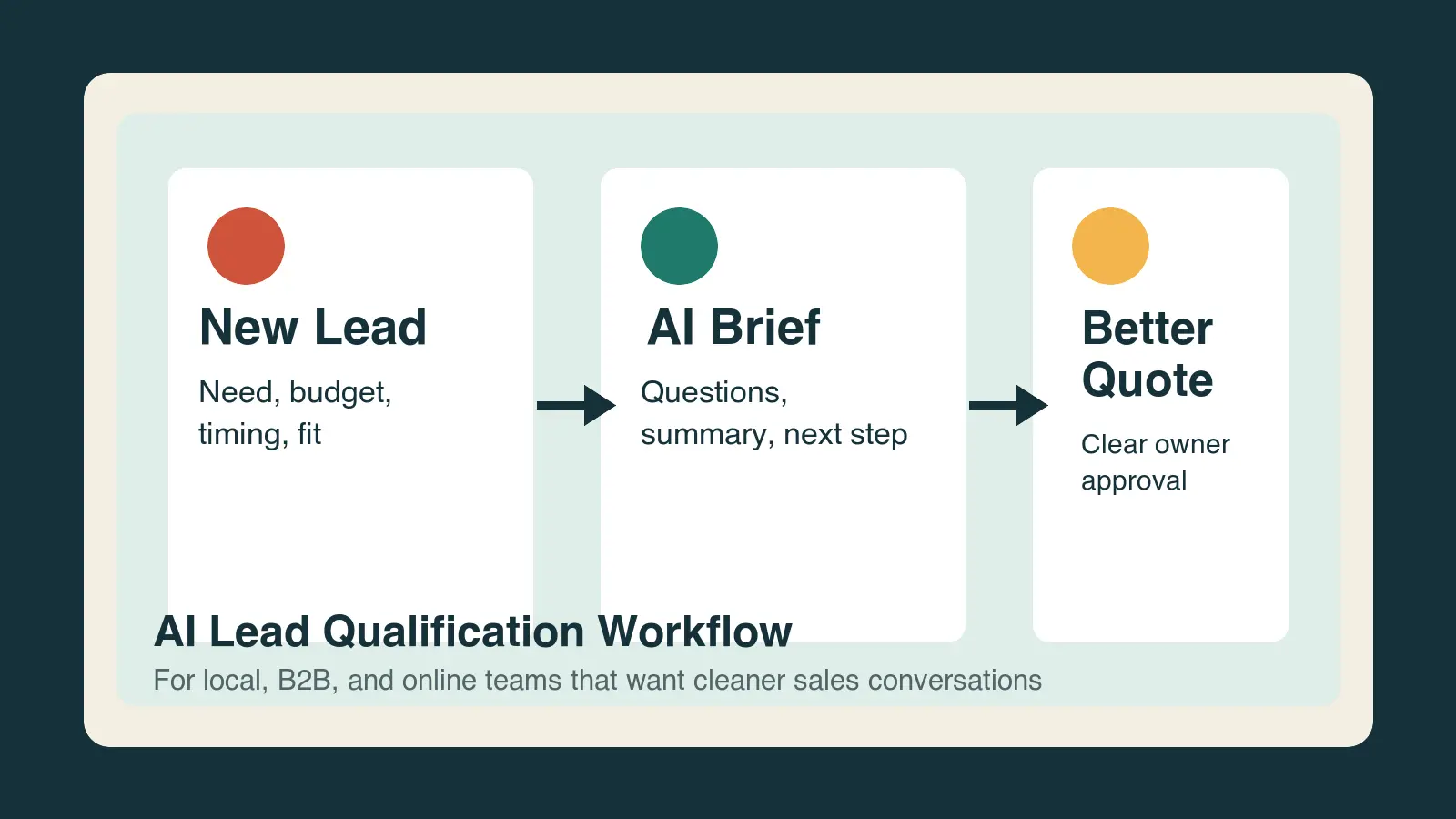
AI lead qualification helps small business owners, B2B and online business owners, employees, and managers ask better questions before they quote, sell, or follow up. The practical goal is simple: use AI to turn messy lead information into a clear buyer summary, fit score, missing-question list, and next step, while a human still reviews the facts, promises, pricing, and relationship.
What is AI lead qualification for a small business?
AI lead qualification is the use of artificial intelligence to help collect, summarize, organize, and prioritize lead information before a sales conversation, quote, proposal, appointment, or follow-up. It can help a business see who the buyer is, what they need, how urgent the problem is, whether the offer fits, what question is still missing, and what action should happen next.
The U.S. Small Business Administration says small businesses can use AI to improve efficiency, make better decisions, take on repeat tasks, and create business content, while also thinking about risks. Lead qualification is a good example because the work is repetitive, information-heavy, and easy to improve with a manager-approved checklist.
Why does lead qualification matter before a quote?
Many businesses lose money by quoting too early. They hear a lead ask for price, rush to respond, and never learn the real problem, timeline, decision-maker, comparison point, or reason the buyer reached out now. AI cannot fix a weak sales process by itself, but it can make the right process easier to repeat.
- A contractor can avoid visiting the wrong job by asking the right project and timing questions first.
- A salon, clinic, gym, or local service business can route urgent, repeat, and first-time inquiries differently.
- A B2B company can tell the difference between a curious researcher and a serious buyer with a current problem.
- An online business can segment webinar attendees, trial users, old leads, and proposal prospects before follow-up.
- Employees can give managers cleaner summaries instead of forwarding long threads with no recommendation.
What information should AI qualify first?
A simple qualification workflow should answer five questions before the business spends time on a quote, proposal, or long follow-up. These questions work for local businesses, service teams, sales reps, managers, and B2B operators because they focus on decision quality instead of clever sales language.
1. What problem is the buyer trying to solve?
Ask AI to summarize the lead problem in one sentence using only the information the buyer provided. If the problem is vague, AI should list the missing questions instead of pretending the buyer is ready.
2. How urgent is the need?
Urgency changes the next step. A leaking roof, missed payroll issue, expired software contract, failed ad campaign, or upcoming launch should not be treated like a casual research request.
3. Is there budget or buying readiness?
Budget qualification does not have to be pushy. AI can help create plain-English questions that ask whether the buyer has a range, priority, approval process, or expected timeline before the team prepares a detailed recommendation.
4. Who needs to approve the decision?
For local businesses, the decision-maker may be a homeowner, spouse, office manager, owner, or department lead. For B2B and online businesses, it may be a founder, marketing manager, sales leader, finance contact, or client stakeholder. AI can flag when the decision role is unknown.
5. What is the next best step?
The output should recommend one clear action: answer the simple question, ask missing questions, book a call, schedule an estimate, send a proposal, route to a manager, disqualify politely, or add the lead to a nurture sequence.
How can a local business use AI lead qualification?
A local business can use AI lead qualification at the front desk, in the inbox, after phone calls, or before estimates. The biggest win is consistency. Instead of every employee asking different questions, the business can create an approved intake checklist and let AI help summarize the answers.
A local service business example, start to finish
A plumbing, HVAC, roofing, landscaping, dental, med spa, salon, or auto repair business could give AI a lead message and ask it to produce a one-paragraph summary, urgency rating, missing questions, recommended service category, and front-desk reply. A manager should approve the categories, pricing language, and escalation rules before the team uses the workflow.
- Collect the lead message, phone notes, form answers, or chat transcript.
- Remove sensitive details that are not needed for the qualification task.
- Ask AI to summarize the need, urgency, service fit, missing details, and recommended next step.
- Have an employee confirm the facts against the original message.
- Send a short reply that asks only the most important missing questions or books the next step.
How can B2B and online businesses use AI lead qualification?
B2B and online businesses usually need qualification across a longer sales path: webinar signups, lead magnets, demos, proposal requests, trial users, sales calls, inbound emails, and abandoned checkout conversations. AI can help summarize the path so a manager or salesperson does not have to read everything from scratch.
- After a discovery call, AI can summarize pain points, objections, stakeholders, timeline, budget clues, and promised follow-up.
- After a webinar or seminar, AI can separate attendees who asked buying questions from people who only wanted general education.
- After a proposal request, AI can create a missing-information checklist before the team writes a custom proposal.
- After a trial or demo, AI can summarize usage notes, support questions, and the highest-fit follow-up angle.
- After a sales inbox thread, AI can draft a concise manager brief with recommended next action.
What should employees and managers do with AI-qualified leads?
Employees and managers should treat AI-qualified leads as a draft work product. That means the AI output helps the team move faster, but it does not become the final decision without review. This is where employees can become more valuable: they can turn scattered lead data into clean, decision-ready summaries.
- Check the AI summary against the original lead source.
- Remove invented details, unsupported claims, or assumptions about the buyer.
- Highlight the buyer problem, urgency, budget clue, decision role, and missing question.
- Recommend the next step in one sentence.
- Send the brief to the owner, manager, or salesperson with the original context attached.
What are the safest AI lead qualification rules?
Lead qualification touches customer data, sales claims, and sometimes sensitive information. NIST describes its AI Risk Management Framework as a voluntary way to incorporate trustworthiness considerations into AI design, use, and evaluation. For a small business, the plain-English version is to decide what AI is allowed to see, what it is allowed to recommend, and who approves the final action.
The Federal Trade Commission continues to scrutinize deceptive AI claims and unsupported performance promises. That matters for lead qualification because AI should not invent testimonials, guarantees, savings, earnings, outcomes, medical claims, legal advice, or pricing commitments. It should organize what is known and ask for what is missing.
- Do not paste unnecessary sensitive customer data into an AI tool.
- Do not let AI invent buyer details, testimonials, guarantees, prices, or outcomes.
- Do not use AI scores as the only reason to deny service, credit, employment, housing, insurance, or other high-stakes opportunities.
- Do keep human review on all quotes, proposals, claims, pricing, and disqualification messages.
- Do create approved templates for employees so the workflow is consistent.
- Do ask qualified counsel for regulated, high-stakes, medical, financial, legal, employment, or automated decision workflows.
What is a practical AI lead qualification prompt?
Use this prompt as a reviewable starting point: Act as a practical sales operations assistant for a [business type]. Review this lead information: [paste message, notes, or transcript]. Use only the provided facts. Create a short lead summary, problem statement, urgency level, fit assessment, missing questions, possible objections, recommended next step, and a draft reply. Do not invent budget, promises, testimonials, results, pricing, timelines, or private facts. Add a human review checklist before sending.
What should an AI-qualified lead summary include?
A good lead summary should be short enough for a busy owner or manager to understand quickly. If the summary takes longer to read than the original message, it is not doing its job.
- Lead source: form, phone, email, referral, ad, webinar, seminar, review, social, or walk-in.
- Buyer problem: the need in one plain-English sentence.
- Urgency: low, medium, high, or unknown, with the reason.
- Fit: strong, possible, weak, or unknown, with the reason.
- Missing questions: the smallest set of questions needed before quoting or selling.
- Risk notes: claims, privacy, pricing, sensitive information, or approval issues.
- Next step: one recommended action and one draft message.
How Winning With AI teaches sales workflows live
Winning With AI is a live AI seminar for business owners, employees, and managers who want practical AI workflows explained in plain English. AI lead qualification is a strong seminar workflow because it connects directly to leads, quotes, follow-up, sales conversations, employee productivity, and manager decisions.
At Winning With AI, the point is not to hand people another list of tools. The point is to show how a real business can brief AI, review the output, protect trust, and turn messy sales information into a cleaner next step. WinningWithAI.com helps local, B2B, and online teams find a Winning With AI seminar near them.
What else do people ask about AI lead qualification?
Can AI qualify sales leads for a small business?
Yes. AI can help qualify sales leads by summarizing the buyer problem, urgency, fit, missing information, objections, and recommended next step. A human should still review the original lead and approve the final message.
Is AI lead scoring the same as lead qualification?
No. Lead scoring usually assigns a number or priority level. Lead qualification is broader. It explains the buyer need, fit, timing, missing questions, and next action. Small businesses should start with qualification before trusting a score.
What is the best first AI qualification workflow?
The best first workflow is incoming leads from one channel, such as website forms, quote requests, appointment requests, demo requests, or old proposal replies. Keep the workflow small enough for a manager to review.
Where can I learn AI sales workflows live?
Winning With AI teaches practical AI workflows for owners, employees, and managers in a live seminar format. Visit WinningWithAI.com to find a local seminar and see how AI can help with lead qualification, follow-up, sales scripts, and customer communication.
Qualified leads still need clear messaging, so pair this process with a nontechnical AI marketing system and the B2B and online business AI workflow guide. The Winning With AI program demonstrates how qualification, follow-up, and campaign work connect.
Find a Winning With AI Seminar Near You
Will qualifying leads with AI put buyers off?
Not if the questions stay the ones a good salesperson would ask anyway: what the job is, when it needs doing, and what matters most about it. Buyers object to interrogation, not to competence. The failure mode is a long form that reads as a filter before anyone has shown they understand the problem.
Should AI decide which leads to ignore?
No. It should summarise and rank so a person can decide faster, and the difference matters. A lead scored low by a summary is often a bad description of a good job. Use the ranking to choose what to call first, not to build a list nobody ever contacts.