AI Strategy | 11 min read
Published | Updated
AI for Small Business: 17 Practical Ways to Get More Leads, Save Time, and Follow Up Faster
Small businesses don’t need AI theory. They need more leads, faster replies, better follow-up, stronger marketing, and more output from the team they already have.

AI for small business means using artificial intelligence to help with the work that normally slows a business down: lead follow-up, customer replies, marketing content, emails, social posts, review requests, research, summaries, offers, ads, and daily decisions. The point isn’t to become technical. The point is to move faster with the business you already have.
What’s AI for small business?
AI for small business is the practical use of tools, agents, and workflows that help owners and teams produce useful work faster. That may mean turning one rough promotion idea into a landing page, email, ad, and follow-up sequence. It may mean summarizing a customer call and drafting the next reply. It may mean creating social posts, review requests, or local service page drafts in minutes instead of waiting weeks.
The important word is practical. Most business owners aren’t asking for a lecture about models, APIs, or prompt engineering. They want to know whether AI can help them get more customers, save time, reduce bottlenecks, and stop losing opportunities because the business is too slow to respond.
Why small businesses should care now
A few years ago, slow follow-up was normal. A customer left a message, filled out a form, or asked for a quote, and everyone understood that the reply might take a day. That expectation is changing. Customers compare faster, search faster, and move on faster. The business that answers first often controls the conversation.
AI gives a small business a way to close that speed gap. It can help draft the reply, organize the details, prepare the estimate handoff, create the follow-up, and remind the team what should happen next. That doesn’t replace the owner or the employee. It gives them a better starting point.
17 practical ways a small business can use AI
- Draft faster replies to customer questions.
- Summarize phone notes, meetings, and messy email threads.
- Create follow-up messages for leads that have gone quiet.
- Write review requests after a job, appointment, or purchase.
- Draft professional review replies for Google Business Profile.
- Turn one promotion idea into emails, social posts, and ad angles.
- Improve weak website copy so the business sounds more credible.
- Create local service page outlines for important offers.
- Build FAQ answers around the questions customers already ask.
- Turn finished jobs or customer wins into social content ideas.
- Create short-video hooks and captions for local awareness.
- Organize old leads into reactivation segments.
- Write internal checklists for repeatable work.
- Create job descriptions, onboarding notes, and training drafts.
- Research competitors and summarize what they appear to be doing well.
- Prepare sales-call notes and objection-handling ideas.
- Map the slowest bottlenecks in marketing, sales, support, and operations.
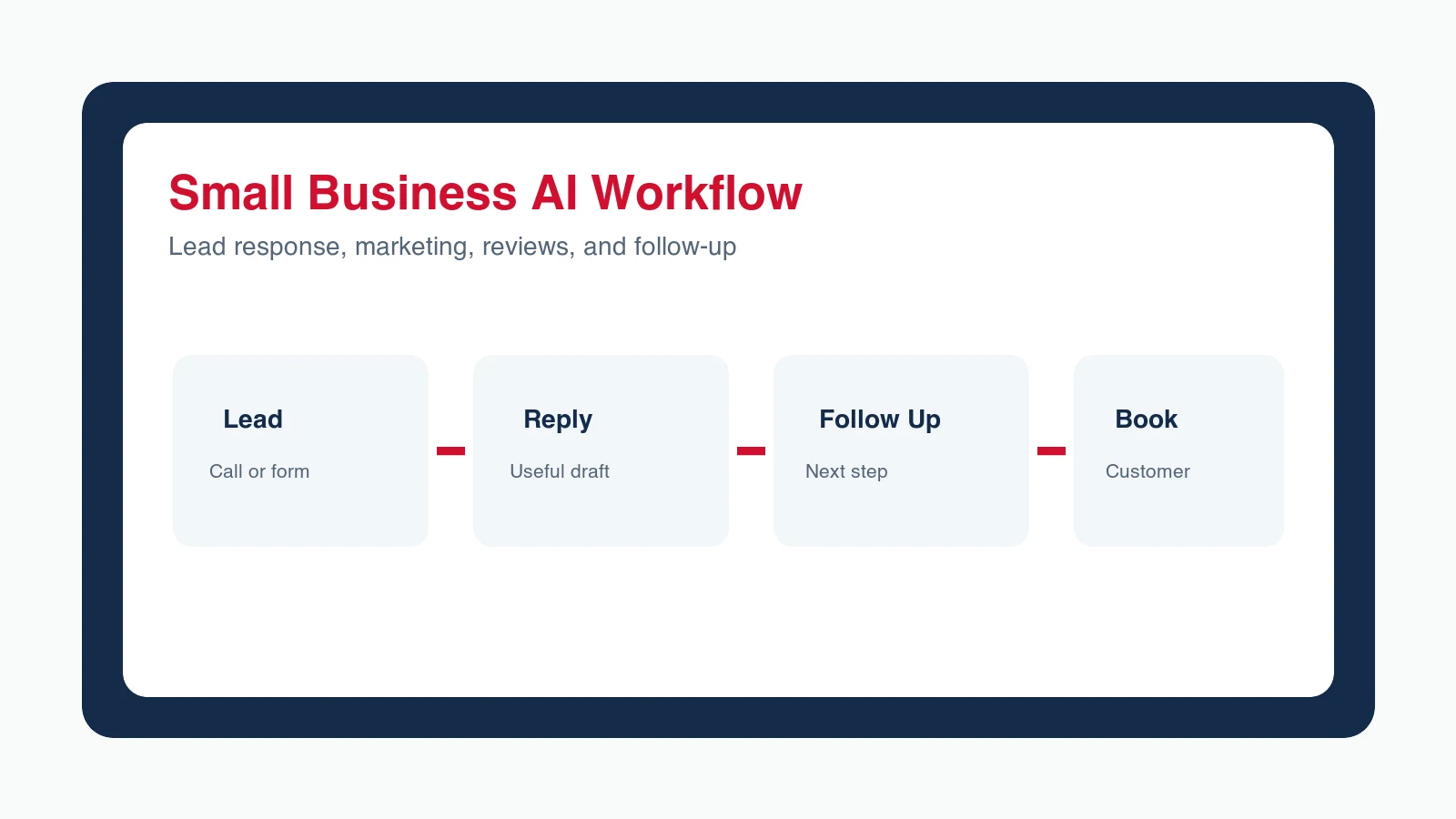
What should a small business automate first?
Start with the work that’s repetitive, visible to customers, and costing the business money when it’s late. For most small businesses, that means lead response, follow-up, review requests, local content, and customer messages. These aren’t exotic AI projects. They’re normal business tasks that often fall through the cracks.
Can AI help a small business get more leads?
AI can help a small business get more leads by improving the assets that create and convert demand. It can help draft stronger landing pages, clearer offers, local service content, social posts, ad ideas, email campaigns, and follow-up messages. AI doesn’t magically create trust. It helps the owner create more of the work that earns trust.
A business with a weak website, inconsistent social media, and slow follow-up can look smaller online than it really is. AI helps fix that gap. It gives the business more chances to show up, explain the value, answer questions, and keep the customer engaged.
The biggest mistake small businesses make with AI
The biggest mistake is treating AI like a search box. A business owner asks one vague question, gets an average answer, and decides AI isn’t useful. That’s not how the leverage appears. The leverage appears when AI is given context, a goal, examples, constraints, and a clear job to do.
Don’t ask AI to "write some marketing." Ask it to create a three-email follow-up for homeowners who requested an HVAC estimate, didn’t book yet, and need a clear reason to choose your company this week. Specific direction creates better output.
Will AI replace employees in a small business?
The better frame is that AI can help employees become more productive and more valuable. A front-desk person who can draft review replies, organize call notes, create follow-up, and prepare customer messages is more useful than one who has to start every task from scratch.
For owners, AI can reduce the pressure to hire before the current team is using modern leverage. For employees, AI can become a career advantage. The person who learns to move work faster becomes harder to ignore.
How to start using AI this week
- List the five tasks your business repeats every week.
- Circle the tasks that touch leads, customers, follow-up, reviews, or marketing.
- Pick one task where speed matters.
- Give AI the goal, audience, context, and desired output.
- Review the draft like an owner, not like a passive user.
- Save the best prompt or workflow so the team can repeat it.
You don’t need a six-month AI plan to begin. You need one repeatable workflow that saves time or protects revenue. Once the team sees one useful result, the next workflow becomes easier to build.
AI for small business FAQ
Is Winning With AI for small business owners?
Yes. Winning With AI is built for owners, operators, employees, and managers who want practical AI workflows for real business work, including leads, marketing, follow-up, customer replies, reviews, and daily output.
Do I need to be technical to use AI in my business?
No. The highest-value first steps usually come from clear business direction, not technical skill. If you can explain the customer, the goal, the offer, and the next step, AI can help create a useful first draft.
How do I find a Winning With AI seminar near me?
Go to WinningWithAI.com and choose the city or event closest to you. The page will show the local seminar details and the next step to reserve a seat.
What does AI cost a small business to get started?
Less than most owners expect, because the starting point is a general assistant rather than a stack of specialised platforms. The real cost is attention in the first fortnight while the habit forms. Adding paid tools before that habit exists is the most common way small businesses spend money and see nothing.
How do I pick which of these seventeen uses to try first?
Pick the job that is repetitive, currently getting skipped, and directly connected to money. For most small businesses that is replying to enquiries or following up on quotes. Starting with the most interesting use rather than the most expensive one is why plenty of experiments never turn into anything.
What should a small business avoid doing with AI in the first month?
Rebuilding processes that already work, and publishing anything unread. The early value is in speed on existing tasks, not in redesigning the business around a tool you have used for three weeks. Anything customer-facing gets read by a person before it goes out, without exception.
See practical AI for small business live
Reading about AI helps, but seeing it build real business work live is different. At Winning With AI, Mike Filsaime and the team show practical workflows for pages, emails, ads, follow-up, customer replies, local content, and daily business output in plain English.
Owners who want to turn these ideas into team habits can use the AI guide for employees and managers alongside an employee AI training checklist. The Winning With AI seminar overview shows how those workflows connect in a live setting.