Tools & Workflows | 11 min read
Published
AI Prompt Checklist for Business: How Owners, Managers, and Employees Get Better Results
Use this plain-English AI prompt checklist to give AI better context, clearer constraints, and a human review step before business output goes public.
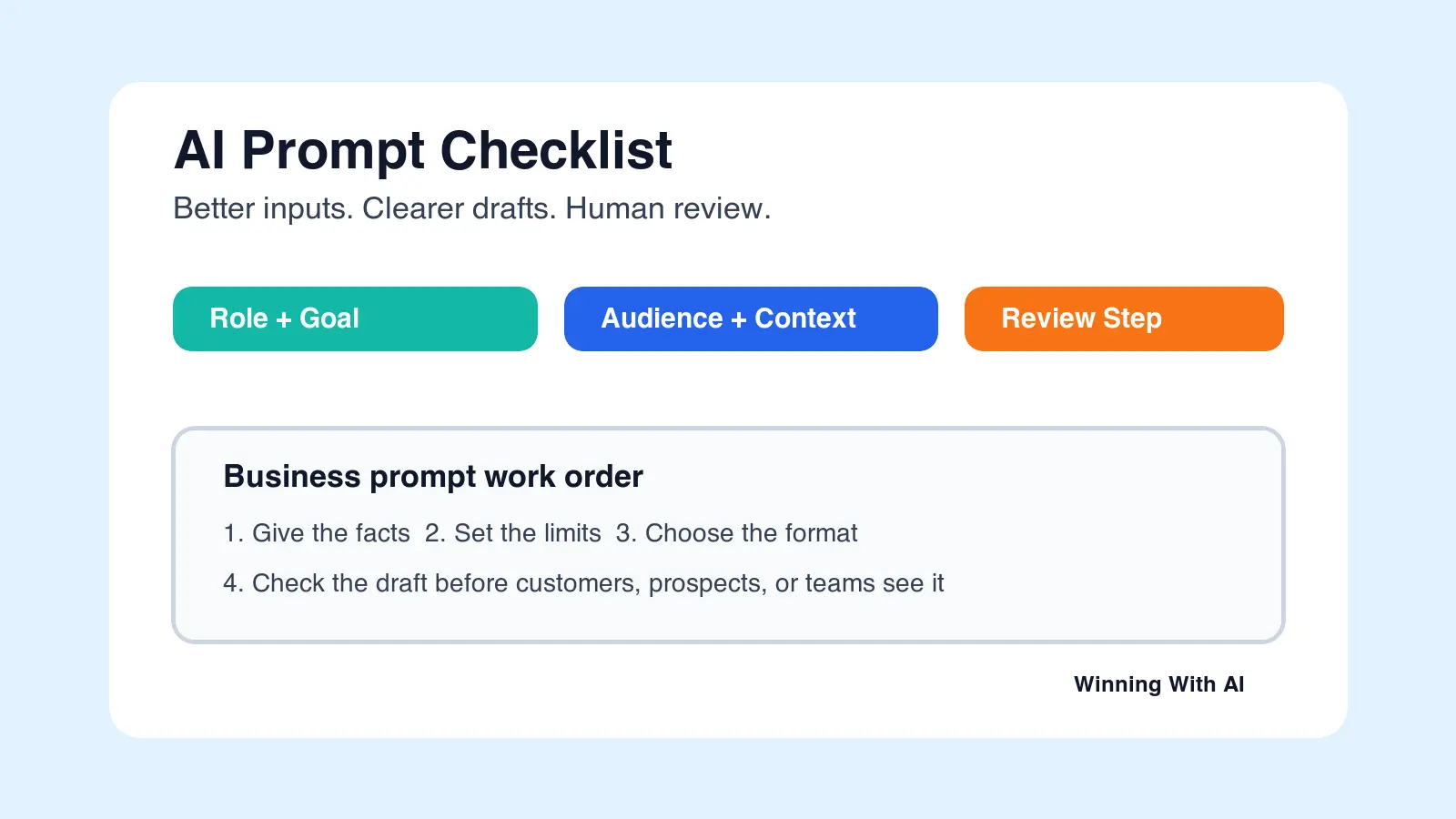
A good AI prompt for business tells the AI the role, goal, audience, context, source material, constraints, format, and review standard before asking for output. That matters for local business owners, B2B and online business owners, employees, and managers because weak prompts usually create vague drafts, while clear prompts create work a person can review, improve, and use faster.
What is an AI prompt checklist for business?
An AI prompt checklist is a short set of questions you answer before asking AI to draft, summarize, analyze, rewrite, or plan something. It helps you give the AI enough useful information to produce a better first draft while reminding you what still needs human judgment.
For a small business, the checklist prevents the most common AI problem: asking a broad question and getting a broad answer. For a team, it creates consistency. The owner, manager, or employee can reuse the same structure for follow-up emails, review replies, meeting summaries, sales notes, social posts, FAQs, proposals, and internal checklists.
What should every business AI prompt include?
Every useful business prompt should include enough direction for AI to understand the job and enough limits to keep the draft useful. You do not need complicated prompt engineering language. You need the same clarity you would give a capable assistant on your team.
- Role: who the AI should act as, such as a customer service assistant, sales coordinator, office manager, marketing strategist, or operations helper.
- Goal: the business outcome you want, such as a reply, summary, outline, checklist, follow-up, comparison, or first draft.
- Audience: who will read or use the output, including customers, leads, employees, vendors, executives, or local searchers.
- Context: what the business does, what situation caused the request, and what the reader already knows.
- Source material: the notes, transcript, review, offer, policy, call summary, or facts the AI should use.
- Constraints: what the AI must avoid, including unsupported claims, private information, pricing promises, technical jargon, fake urgency, or off-brand tone.
- Format: the structure you want, such as bullets, email, SMS, table-style list, checklist, subject lines, headline options, or step-by-step plan.
- Review standard: the human checks required before the output is sent, published, or copied into a system.
How do you write a better AI prompt in plain English?
Write the prompt like a clear work order. Start with the job, add the facts, state the reader, define the tone, set the limits, and ask for a specific format. If the first answer is too generic, do not start over randomly. Add the missing context and ask AI to revise against a clearer standard.
What a weak prompt looks like
Write a follow-up email for a lead.
What a better business prompt looks like
Act as a helpful sales coordinator for a local HVAC company. Draft a friendly follow-up email to a homeowner who asked about replacing an old air conditioner but has not booked an estimate. Use a helpful, professional tone. Do not promise pricing, discounts, same-day availability, or financing approval. Keep it under 120 words and end with one clear next step: reply to choose a time for an estimate.
What prompt checklist should local business owners use?
Local business owners should use prompts that preserve local context, customer trust, and operational accuracy. The AI should know the service, location, customer situation, business tone, and next step before drafting anything a customer might see.
- What service, product, appointment, or customer question is involved?
- What city, neighborhood, service area, or location detail matters?
- What facts are confirmed, and what should not be guessed?
- What tone should match the business: warm, professional, direct, premium, casual, or reassuring?
- What should the customer do next: call, book, reply, review, confirm, upload, or visit?
- What must a person check before the message is sent or posted?
What prompt checklist should B2B and online teams use?
B2B and online teams should give AI enough market, offer, audience, and stage-of-funnel context. A landing page draft, proposal outline, campaign email, or customer success update will be weak if the AI does not know the buyer, the problem, the proof, the offer, and the conversion goal.
- Who is the buyer or user, and what problem are they trying to solve?
- What offer, product, service, webinar, demo, or next step is being promoted?
- What proof, customer language, objections, or source notes should shape the draft?
- Where will this output be used: sales email, landing page, proposal, ad, onboarding, support, or executive update?
- What tone fits the brand and buyer stage?
- What claim, guarantee, statistic, or comparison must be verified before publishing?
How can employees and managers use prompt checklists at work?
Employees and managers can use prompt checklists to turn messy work into cleaner output. The best workplace prompts do not ask AI to make final decisions. They ask AI to organize notes, draft options, summarize decisions, identify missing information, or create a first version that a person can approve.
- Meeting notes: ask for decisions, owners, due dates, risks, and follow-up questions.
- Email drafts: provide the relationship, goal, tone, facts, constraints, and desired action.
- Manager updates: ask for concise progress, blockers, priorities, and next steps.
- Training materials: provide the process notes and ask for a plain-English checklist.
- Customer messages: include the real customer issue and ask AI to avoid promises the company cannot keep.
What is a reusable AI prompt framework?
A reusable AI prompt framework is a fill-in-the-blank structure for a repeated task. It lets a business improve one prompt pattern over time instead of relying on each person to invent a new instruction every time.
Use this pattern: Act as [role] for [business type]. Help with [task]. Use this source material: [paste notes]. The audience is [reader]. The goal is [business outcome]. The tone should be [tone]. Do not [blocked claims or data]. Format the answer as [format]. Before finalizing, check for [review criteria].
What mistakes make AI prompts fail?
AI prompts fail when they leave out the real business situation. The output may sound polished, but polished is not the same as accurate, useful, on-brand, or safe. Owners and managers should teach teams to improve the instruction before blaming the tool.
- Asking for a final answer when you really need a first draft.
- Leaving out the audience, goal, tone, or next step.
- Pasting sensitive customer or employee information that the task does not require.
- Asking AI to invent proof, testimonials, prices, policies, or guarantees.
- Using the same prompt for every audience and every channel.
- Skipping the human review because the draft sounds confident.
How Winning With AI teaches better prompting
Winning With AI teaches prompting as a practical business skill, not as a collection of clever phrases. At a live AI seminar, owners, employees, and managers can see how the same task changes when the prompt includes the right role, context, source material, constraints, and review standard.
That live demonstration matters because most people understand AI faster when they watch a rough request become a useful business workflow. The goal is to leave with a way of thinking: brief AI clearly, inspect the output, improve the instruction, and keep the human accountable for the final result.
What else do people ask about AI prompt checklists?
What is the simplest AI prompt formula?
The simplest formula is role plus goal plus context plus constraints plus format. Tell AI who to act as, what to create, what facts to use, what to avoid, and how you want the answer structured.
Should every employee use the same AI prompts?
Employees should use the same approved prompt patterns for repeated tasks, but they should adapt the source material and review the output for each real situation. A reusable prompt is a starting point, not an autopilot.
Can AI prompts replace training?
No. Prompts can support training by giving people clearer workflows, but employees still need examples, review standards, approval rules, and feedback from a manager or owner.
Where can I learn AI prompts for business live?
Winning With AI is a live AI seminar for business owners, employees, and managers who want practical prompting, workflows, and business examples in plain English. Visit WinningWithAI.com and find a local seminar near you.
Better prompts are one layer of a system; next, learn where AI agents can help business owners and how to use AI competitor analysis without guessing. The practical AI program curriculum connects these skills to broader workflows.
Find a Winning With AI Seminar Near You
How long should a business AI prompt be?
Long enough to carry the context a competent freelancer would need and no longer. In practice that is a short paragraph: what it is for, who reads it, what must be included, what to avoid, and how long. Very short prompts produce generic work; very long ones produce work that ignores half the instruction.
Should prompts be saved and reused across a team?
Yes, and this is where most of the value shows up. A prompt that has been refined over a dozen uses is a small piece of company process, and handing it to a new starter gets them to a decent first draft on day one. Keep them somewhere shared rather than in individual chat histories.