Marketing & Sales | 11 min read
Published
AI Sales Scripts for Small Business: Better Calls, Follow-Ups, and Objection Replies
Use AI to turn real offers, customer questions, and sales notes into clearer call scripts, follow-up messages, and objection replies your team can actually use.
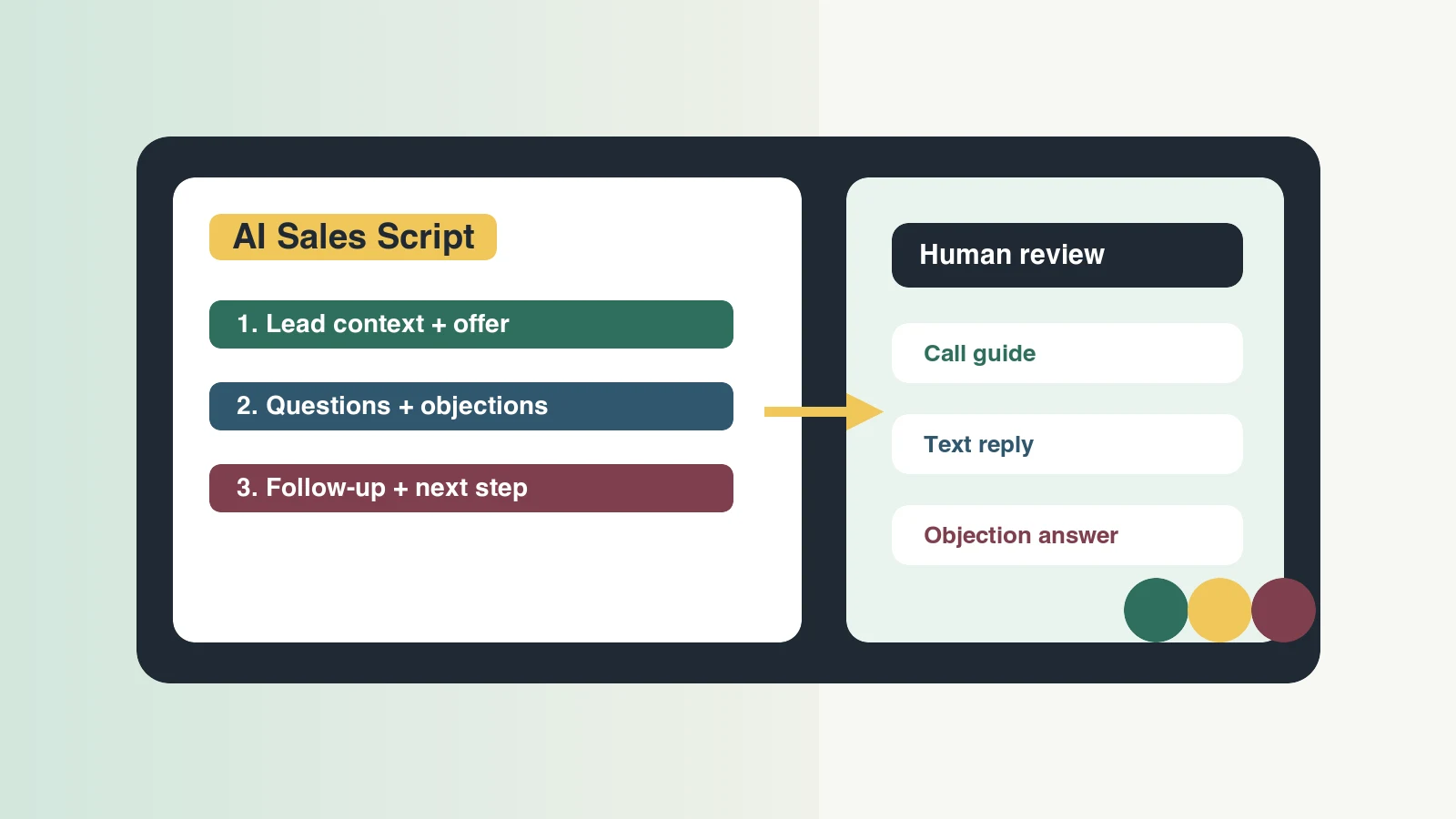
AI sales scripts help small business owners, B2B and online business owners, employees, and managers turn messy sales notes into clearer calls, follow-ups, and objection replies. The goal is not to make people sound robotic. The goal is to give the team better questions, better structure, and better next steps before they speak with a prospect or customer.
What are AI sales scripts for a small business?
AI sales scripts are draft conversation guides created with an AI tool from your offer, audience, customer situation, objections, and desired next step. A useful script includes the opening, discovery questions, proof points, objection replies, and a clear close. It should sound like your business, not like a generic sales manual.
For owners and managers, the real value is consistency. AI can help create a repeatable starting point for the conversations that happen every week: new lead calls, quote follow-up, abandoned booking follow-up, demo reminders, proposal nudges, and customer check-ins.
When should a business use AI for sales scripts?
Use AI for sales scripts when the conversation is important, repeated, and easy to improve with better wording or better structure. Do not wait until the whole sales process is perfect. Start with the moments where prospects hesitate, ask the same questions, or stop responding.
- A local service lead asks for a quote but does not book an appointment.
- A restaurant, salon, clinic, contractor, or home service company misses a phone call and needs a fast callback script.
- A B2B lead books a discovery call and the salesperson needs better questions.
- A proposal has been sent and the prospect has gone quiet.
- A customer says the price is too high, needs to ask a partner, or wants to think about it.
- A manager wants newer employees to handle common questions more confidently.
What should you give AI before asking for a script?
AI writes stronger sales scripts when it has the same context you would give a capable sales assistant. If the prompt only says write me a sales script, the answer will usually be polished but generic. Better inputs make the script more specific, useful, and reviewable.
- Offer: the product, service, package, appointment, estimate, demo, or next step being sold.
- Audience: the type of prospect, buyer, customer, owner, manager, or decision maker.
- Situation: what the prospect asked, did, downloaded, booked, missed, or objected to.
- Proof: examples, outcomes, testimonials, guarantees, reviews, case details, or credibility points that are true and approved.
- Constraints: pricing rules, compliance limits, promises to avoid, service area limits, and anything the team cannot guarantee.
- Tone: helpful, direct, premium, friendly, consultative, concise, reassuring, or professional.
- Close: the one next action you want, such as book the estimate, choose a call time, approve the proposal, reply with a question, or attend a seminar.
How can local businesses use AI sales scripts?
Local businesses usually win more from speed, clarity, and trust than from clever sales language. AI can help a local team respond faster while keeping the message accurate and human. The owner or manager should approve the pattern, then employees can adapt it to each real customer situation.
A script for calling a missed enquiry back
A missed call script should acknowledge the missed call, identify the likely need, ask one simple question, and make booking easy. For example, a home services company might ask AI for a 45-second callback script that confirms the service needed, the location, and the best time for an estimate without promising same-day availability.
A script for following up on an estimate
An estimate follow-up script should be helpful, not pushy. AI can draft a call guide and a short text that reminds the prospect what was discussed, answers the most common concern, and asks whether they want to move forward, adjust the scope, or ask a question.
A script for asking for a review or referral
After a happy customer interaction, AI can draft a simple script for asking for a review or referral. The script should be short, specific to the service, and easy for the employee to say naturally.
How can B2B and online teams use AI sales scripts?
B2B and online teams need scripts that support longer buying decisions. AI can help sales reps, founders, account managers, and customer success teams prepare for calls without creating stiff talk tracks. Use a one-page AI sales meeting brief to separate verified account facts from open questions before choosing the script, proof, and next action.
- Discovery calls: turn intake notes into better questions about goals, urgency, budget, authority, and decision process.
- Demo calls: tailor the opening and proof points to the buyer segment instead of giving the same tour to everyone.
- Proposal follow-up: summarize the business case, answer likely objections, and ask for the next decision.
- Renewals and expansions: prepare questions about results, usage, blockers, and the next opportunity.
- Onboarding handoffs: create a clear transition script from sales promise to delivery expectations.
What is a practical AI sales script prompt?
Use this prompt pattern when you need a script the team can review quickly: Act as a practical sales manager for [business type]. Create a [call script, text follow-up, email follow-up, objection reply, or discovery guide] for [prospect type] who [situation]. The offer is [offer]. The goal is [next step]. Use these approved facts: [facts]. Avoid [claims, promises, pricing, pressure, or private data]. Make it sound [tone]. Include questions, likely objections, and a short human review checklist.
How should employees use AI sales scripts without sounding fake?
Employees should treat AI sales scripts as preparation, not as lines to read word for word. The script helps them remember the opening, questions, proof, and close. The employee still needs to listen, pause, ask follow-up questions, and respond to the actual person in front of them.
- Read the script once, then rewrite it in your normal speaking style.
- Keep the first sentence short so the conversation starts naturally.
- Use questions from the script, but do not force every question into every call.
- Mark any claim that needs owner or manager approval before use.
- After real calls, add better phrases and objections back into the prompt for the next version.
What mistakes make AI sales scripts fail?
AI sales scripts fail when they sound polished but ignore the real selling situation. A script must match the offer, customer stage, service constraints, and the person using it. Owners and managers should review scripts before giving them to the team.
- Using a generic script that does not mention the real offer or buyer problem.
- Letting AI invent proof, guarantees, prices, discounts, timelines, or customer results.
- Making the script too long for a normal phone call or text follow-up.
- Skipping objection handling because the opening sounds good.
- Giving employees a script without teaching them when to adapt it.
- Failing to collect real sales-call feedback and improve the prompt over time.
How Winning With AI helps teams build sales scripts live
Winning With AI shows business owners, employees, and managers how to turn everyday sales conversations into AI-supported workflows. At a live AI seminar, it is easier to see the difference between a generic script and a script built from a real offer, real objections, real follow-up needs, and a clear business outcome.
That matters because sales scripts are not just copy. They are training, follow-up, customer experience, and revenue support. When a team learns how to brief AI clearly, review the output, and improve the workflow, AI becomes more than a writing tool. It becomes a practical sales support system.
What else do people ask about AI sales scripts?
Can AI write a sales script for my business?
Yes, AI can draft a sales script for your business when you provide your offer, audience, customer situation, proof, constraints, tone, and next step. A person should still review the script before using it with prospects.
Should employees read AI sales scripts word for word?
Usually no. Employees should use the script to prepare the conversation, remember the important questions, and choose the next step. Reading word for word often sounds stiff unless the channel requires exact wording.
What is the best first AI sales script to create?
The best first script is the conversation your team repeats often and currently handles inconsistently. For many businesses, that is a missed-call callback, quote follow-up, proposal follow-up, or common objection reply.
Where can I learn AI sales scripts for business live?
Winning With AI is a live AI seminar for owners, employees, and managers who want practical business workflows, including scripts, follow-ups, prompts, and sales support examples. Visit WinningWithAI.com to find a local seminar near you.
Support the script with content that can surface in AI answers using the small-business answer engine optimization guide and a consistent AI content calendar for posts, emails, and offers. To practice these workflows in person, find a local Winning With AI seminar.
Once the prompt produces a useful draft, use this business AI fact-checking checklist to verify claims, numbers, sources, promises, and next actions before anyone approves the output.
Find a Winning With AI Seminar Near You
How do I keep an AI sales script from sounding rehearsed?
Use it as a structure rather than as lines to read. Keep the order of the conversation, the questions, and the two or three phrases that genuinely land, and let everything else be said normally. Reading a script aloud is what customers hear as insincerity, not the fact that one exists.
Can AI help handle objections I get all the time?
This is one of its better uses, because a recurring objection deserves a considered answer and almost never gets one under pressure. Draft the three responses you would want to give when calm, test them for a fortnight, and keep what works. The improvement compounds in a way improvising does not.