AI Strategy | 10 min read
Published
AI Readiness Checklist for Small Business: 10 Steps Before You Buy Tools or Train Your Team
Before a small business buys AI tools, it needs a clear readiness checklist: pick workflows, protect data, train people, and measure useful output.
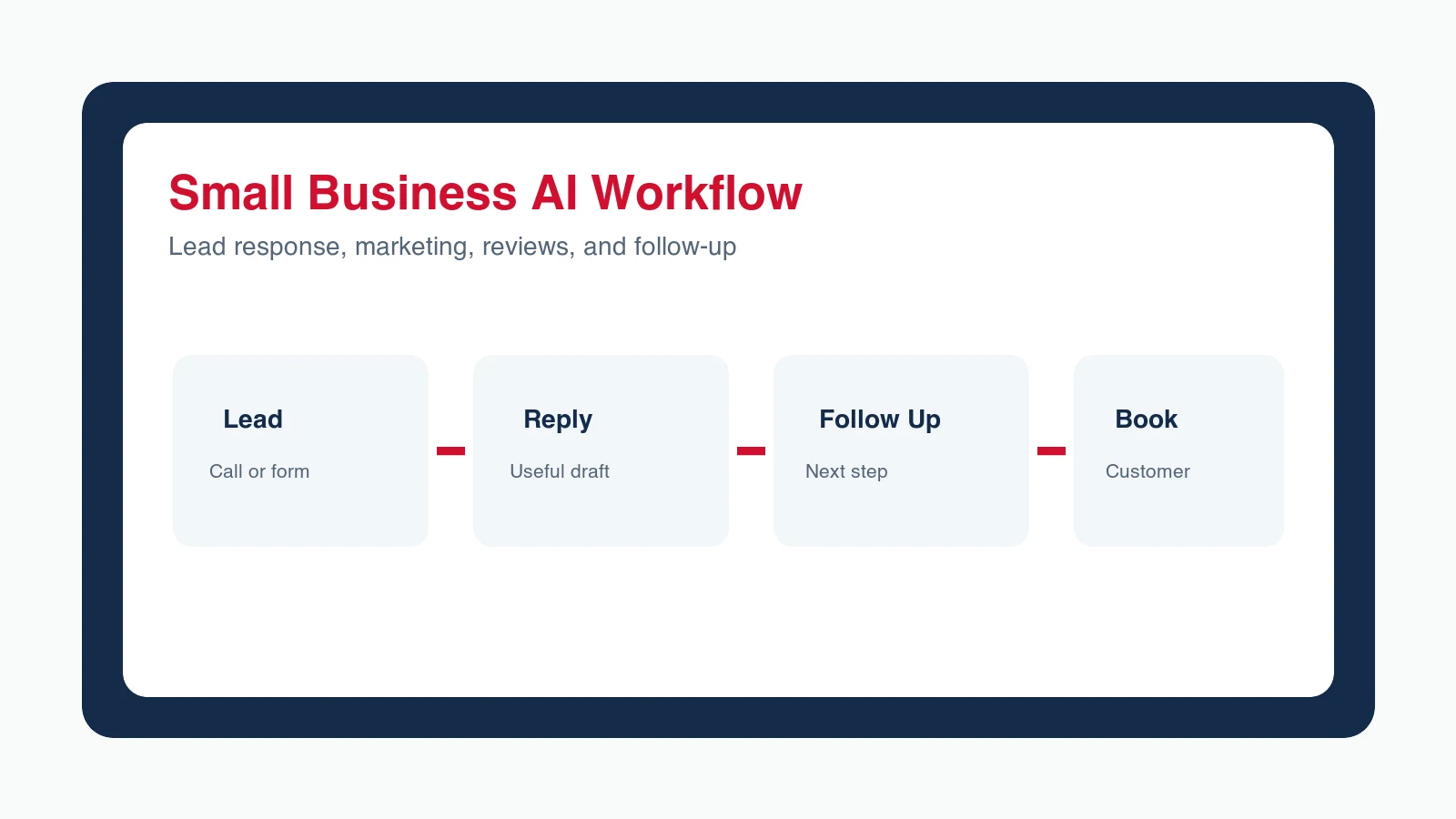
An AI readiness checklist helps a small business decide where AI should be used, who should use it, what data must stay protected, which outputs need review, and how the team will measure whether AI is actually helping. For local business owners, B2B and online business owners, employees, and managers, readiness matters more than buying another tool because AI only creates value when it fits a real workflow.
What does AI readiness mean for a small business?
AI readiness means the business is prepared to use AI on purpose. It does not mean the company has expensive software, a technical team, or a perfect automation plan. It means the owner or manager can point to a few real tasks, explain what AI is allowed to do, protect sensitive information, and make sure a person still owns the final result.
The U.S. Small Business Administration describes AI as a way small businesses can improve efficiency, create reusable templates, summarize meetings, support content, brainstorm, and use business data more effectively. That is the right starting mindset: choose practical work first, then choose tools.
Who should use this AI readiness checklist?
This checklist is for owners and managers who feel pressure to adopt AI but do not want scattered experiments to create risk, confusion, or wasted subscriptions. It also helps employees who want to become more valuable by using AI responsibly instead of casually trying tools without guidance.
What local business owners get from this
Local business owners can use AI readiness to improve lead response, review replies, local content, appointment reminders, estimate follow-up, hiring notes, and customer FAQs without handing sensitive information to random tools.
B2B and online business owners
B2B and online owners can use readiness planning to speed up campaigns, proposals, onboarding, sales notes, customer updates, authority content, and internal documentation while keeping claims, client details, and final approvals under control.
What employees and managers get from this
Employees and managers can use the checklist to turn AI into a workplace skill: clearer emails, better summaries, cleaner handoffs, stronger meeting notes, first-draft reports, and faster internal communication that still sounds like the business.
The 10-step AI readiness checklist
- Pick three repeated workflows where AI could save time or improve quality.
- Decide which AI tools are approved and who can approve new ones.
- List the private or sensitive data that must not be entered into AI tools.
- Define which tasks are low-risk drafts and which require manager approval.
- Create a human review rule for facts, tone, claims, customer details, and final decisions.
- Write one prompt template for each approved workflow.
- Save approved examples so the team can copy the standard.
- Train employees with real business tasks, not generic AI demos.
- Measure useful output: response time, drafts completed, follow-ups sent, summaries finished, or bottlenecks reduced.
- Review the workflow every month until the habit is stable, then every quarter.
Which AI workflows should a business start with first?
The best first AI workflows are repeated, easy to check, and useful even if AI only creates a first draft. Avoid starting with sensitive decisions, legal conclusions, medical advice, financial promises, hiring decisions, pricing exceptions, or anything that could harm a customer if it is wrong.
- Customer service: draft answers to common questions, then have a person check the facts before sending.
- Lead follow-up: turn an inquiry into a helpful reply, quote follow-up, appointment reminder, or reactivation message.
- Marketing: turn one promotion into a draft email, social post, ad angle, landing page outline, and FAQ list.
- Meetings: summarize notes into decisions, open questions, responsible people, and next steps.
- Operations: create checklists for opening, closing, onboarding, estimates, handoffs, or recurring admin work.
- Sales support: summarize call notes, draft proposal sections, prepare discovery questions, or organize objections.
What data rules should be in place before employees use AI?
Before employees use AI, the business should decide what information cannot be pasted into any tool unless the owner or manager has approved the tool, reviewed the terms, and confirmed the use case. FTC guidance and enforcement activity around AI and privacy make the practical lesson clear: companies still need to honor privacy commitments and avoid misleading people about how data is used.
- Do not enter customer names, phone numbers, emails, addresses, payment details, account numbers, or private complaints without approval.
- Do not enter employee records, payroll, performance notes, medical details, or hiring information without approval.
- Do not enter passwords, API keys, bank information, tax records, vendor contracts, client secrets, or unreleased plans.
- Remove identifying details before asking AI to summarize or rewrite a sensitive message.
- Use approved examples and templates so employees do not invent their own data practices.
How should managers review AI output?
Managers should review AI output by asking whether the draft is accurate, private, on-brand, legally safe, and useful for the customer or team. NIST frames AI risk management around trustworthiness and matching risk actions to an organization's goals and context. In plain English, that means the review should fit the consequence of the task.
- Check facts, names, prices, dates, offers, locations, guarantees, and instructions.
- Remove private information that does not belong in the final message or document.
- Make the tone sound like the business instead of a generic AI answer.
- Flag unsupported claims, fake statistics, fake reviews, or overconfident promises.
- Escalate anything involving legal, financial, medical, employment, safety, compliance, refunds, or major reputation risk.
- Save the improved final version as the new example for the team.
What should AI training for employees include?
AI training for employees should include real tasks from the business, approved prompts, examples of safe and risky use, data rules, review rules, and a clear path for asking questions. A generic tool demo can make AI look impressive for an hour. A workflow demo shows people what to do on Monday morning.
- One customer reply workflow.
- One meeting or notes summary workflow.
- One marketing or follow-up workflow.
- One example of information that must be removed before using AI.
- One example of an AI draft that sounds good but contains a wrong fact.
- One saved template the employee can use immediately.
How do you know if your AI rollout is working?
An AI rollout is working when useful work moves faster, quality improves, and the team understands the rules. Do not measure readiness by the number of tools purchased. Measure it by the business outcomes that matter: faster response, clearer communication, fewer blank-page delays, better follow-up, better internal documentation, and less repeated work.
- Lead response time improved.
- Customer questions are answered more consistently.
- Follow-up messages are drafted and sent faster.
- Meeting notes turn into next steps instead of disappearing.
- Managers spend less time rewriting from scratch.
- Employees know when AI is helpful and when to escalate.
AI readiness mistakes to avoid
- Buying tools before choosing workflows.
- Letting every employee create their own AI process with no shared rules.
- Using AI for customer-facing promises without human review.
- Pasting sensitive customer, employee, vendor, or financial data into unapproved tools.
- Training people on prompts but not on judgment.
- Expecting AI to fix unclear offers, poor follow-up, or messy operations by itself.
How Winning With AI helps teams get ready faster
Winning With AI is built for people who need to see practical AI workflows before the strategy becomes real. At a live AI seminar, local business owners, B2B and online business owners, employees, and managers can watch examples for marketing, customer replies, follow-up, notes, checklists, and productivity in plain English.
That live demonstration helps a team move from scattered curiosity to a shared picture of what AI can do, where it belongs, and how human review keeps the work useful. For many small businesses, that is the readiness step they need before another tool subscription.
What else do people ask about AI readiness?
What is an AI readiness checklist?
An AI readiness checklist is a practical list of workflows, tool rules, data protections, review habits, training steps, and measurements a business should define before AI use spreads across the team.
Do small businesses need an AI strategy before using AI?
A small business does not need a complicated AI strategy, but it does need a short practical plan. Pick a few workflows, protect sensitive data, review important output, and train people with examples from the business.
What is the safest first AI task for a team?
The safest first task is usually a low-risk draft or summary that a person can review quickly, such as a meeting summary, internal checklist, customer FAQ draft, or first-pass follow-up message.
Can employees attend Winning With AI?
Yes. Winning With AI is useful for employees and managers who want to become more capable with AI at work, not only for owners. The seminar is designed to make AI practical for daily business output.
Where is the nearest live AI seminar for small businesses?
Go to WinningWithAI.com, choose the local event or city closest to you, review the seminar details, and reserve your seat.
Once the basics are in place, standardize requests with the AI prompt checklist for business and decide whether AI agents fit your business processes. If you are still choosing use cases, run an AI workflow audit to rank the best first tasks. You can also choose a role-specific AI learning path for owners, employees, and managers.
When the business is ready to compare products, follow the practical checklist for choosing AI tools so vendor demos, pilots, costs, data controls, and exit options are judged against one approved workflow.