Marketing & Sales | 11 min read
Published
AI Referral and Reactivation Campaigns for Small Business: Bring Back Customers Without Sounding Pushy
A practical AI workflow for turning happy customers, old leads, and past buyers into referral and reactivation campaigns your team can review and send.
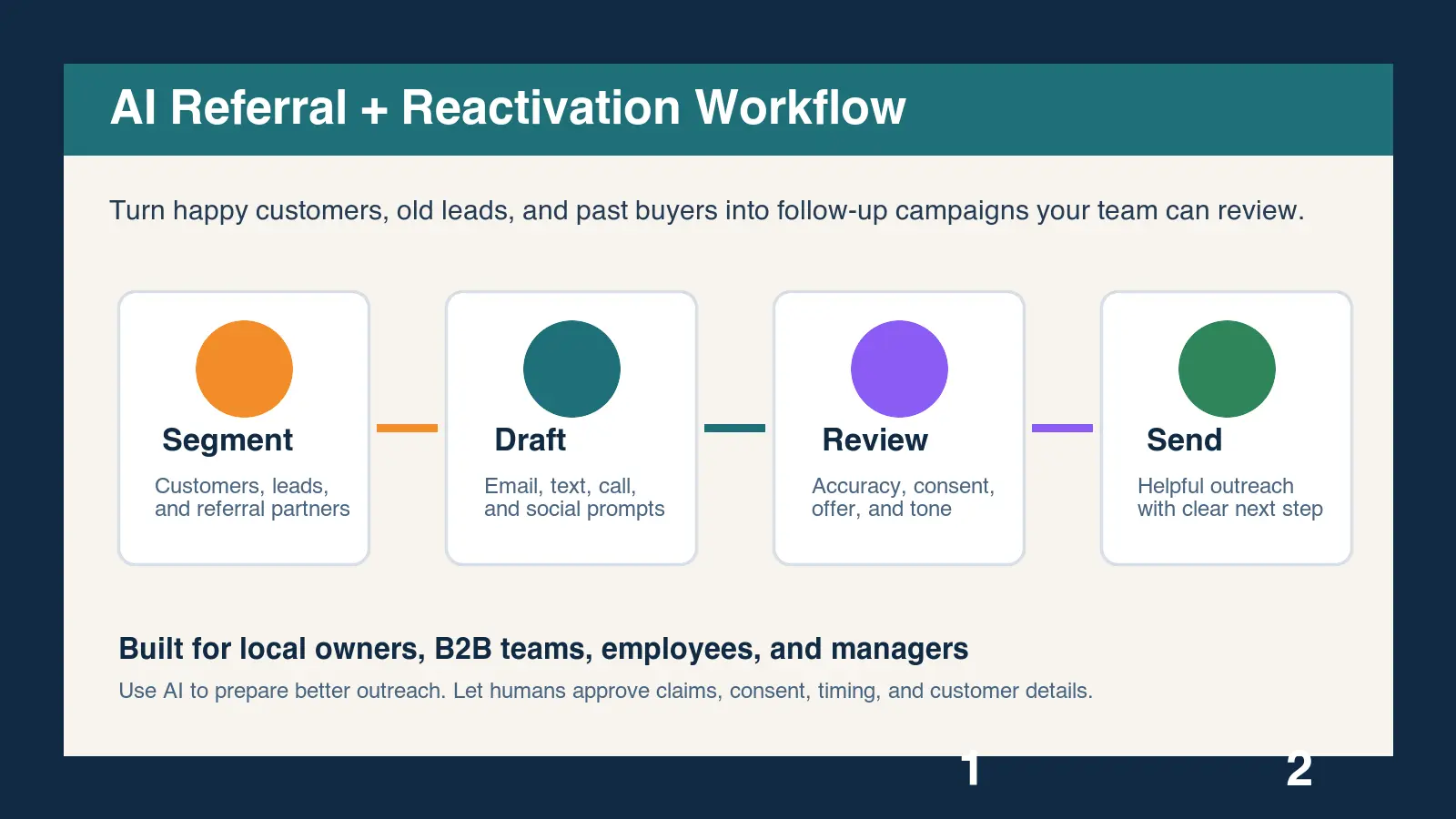
AI referral and reactivation campaigns help small business owners, B2B and online business owners, employees, and managers turn past customers, old leads, happy clients, and referral partners into useful outreach without starting from a blank page. The best use is not blasting everyone with generic messages. The best use is giving AI clean customer segments, approved facts, consent rules, and a clear next step so a human can review the campaign before it goes out.
What is an AI referral campaign for a small business?
An AI referral and reactivation campaign is a structured outreach workflow where AI helps identify the audience, draft messages, prepare call scripts, create email or text variations, and build a review checklist. The audience already has some relationship with the business, which is why the message should feel specific and helpful instead of cold.
The U.S. Small Business Administration describes AI as a way small businesses can improve efficiency and make better use of business data, while also weighing risks. That is the right frame here. AI can help organize the work, but the owner or manager still needs to approve who gets contacted, what is promised, and whether the channel is appropriate.
Who should use this campaign first?
The best first audience is usually not strangers. It is people who already trust the business or nearly bought before. Owners and managers should start with the list that is easiest to understand and safest to review.
- Happy customers who recently had a good outcome and may know someone similar.
- Past customers who have not bought, booked, visited, renewed, or scheduled in several months.
- Old leads who requested a quote, booked a call, attended a webinar, downloaded a resource, or asked a serious question.
- B2B clients who may need renewal, expansion, onboarding help, or a related service.
- Referral partners, vendors, local professionals, affiliates, or community contacts who understand the audience you serve.
- Employees and managers who talk to customers every day and can identify repeated needs, objections, and referral moments.
What should you give AI before it writes the campaign?
AI needs business context before it can draft outreach that sounds useful. If the prompt only says write a referral campaign, the output will usually be polished but thin. Better inputs create messages a real team can review quickly.
- Audience segment: past customers, old leads, lapsed members, renewal candidates, referral partners, or satisfied clients.
- Relationship history: what they bought, asked about, attended, requested, renewed, missed, or used before.
- Reason to reach out now: season, capacity, new service, reminder, event, deadline, review, result, or helpful update.
- Approved offer or next step: book an appointment, request a quote, reply, refer a friend, attend a seminar, renew, or schedule a call.
- Proof and constraints: true reviews, approved examples, policies, exclusions, service areas, pricing limits, and promises to avoid.
- Channel and consent status: email, phone, text, direct message, postal mail, sales call, or in-person follow-up.
- Tone: helpful, grateful, concise, professional, local, consultative, friendly, or direct.
How can local businesses use AI for referrals?
Local businesses can use AI to make referral asks more specific and easier for employees to deliver. The message should connect to the real service, the customer experience, and the kind of person who would be a good fit. A vague ask like send us anyone you know is weaker than a specific ask tied to a need the business solves well.
A local service business example, start to finish
A home services company could ask AI to draft a short email and phone script for customers who just completed a successful project. The script might thank the customer, mention the specific service, ask whether a neighbor or family member needs similar help, and give one simple reply option. The owner should remove any claim that is not true and approve the exact referral incentive, if one exists.
Restaurant, salon, clinic, or gym example
A restaurant, salon, clinic, studio, or gym could use AI to draft a bring-a-friend message for recent satisfied customers. The campaign should be clear about eligibility, timing, and the offer. Employees can use AI to create variations for email, social posts, front-desk scripts, and manager-approved text reminders.
How can B2B and online businesses use AI for reactivation?
B2B and online reactivation campaigns usually need more context than a local reminder. The buyer may have evaluated a proposal, attended a webinar, used a product, paused a subscription, or gone quiet after a sales conversation. AI can help summarize that history and draft outreach that respects the buyer stage.
- Old proposal follow-up: summarize the original problem, decision criteria, and one relevant update.
- Webinar or seminar attendee reactivation: remind them of the topic they cared about and offer a next step.
- Trial or product user reactivation: acknowledge where they stopped and suggest one useful action.
- Past client expansion: connect a new offer to the result or project they already experienced.
- Renewal save campaign: prepare a helpful check-in that asks what changed instead of assuming the sale.
What is the safest way to use AI for email, text, and reviews?
The safest practical rule is simple: AI can draft the outreach, but a human should review the audience, permission, claims, offer, and unsubscribe or opt-out path before anything is sent. This is especially important for email, text messages, reviews, testimonials, referral incentives, and any campaign that mentions customer results.
FTC guidance says endorsement and testimonial issues are evaluated under the FTC Act when relationships, incentives, or claims could mislead people. FTC CAN-SPAM materials apply to commercial email. FCC text-message rules under the TCPA make consent especially important for marketing texts and automated outreach. A small business does not need to turn every campaign into a legal memo, but it should build consent and accuracy checks into the workflow.
Keep the campaign connected to a useful publishing rhythm with AI content repurposing for small business. A customer question or referral story can become a helpful post, email, video outline, and staff answer when each format has a clear job.
What is a practical AI prompt for referral campaigns?
Use this prompt when you want AI to create a reviewable first draft: Act as a practical marketing manager for a [business type]. Build a referral campaign for [audience segment] who recently [customer history]. The goal is [referral ask or next step]. Use these approved facts: [facts]. The incentive or offer is [details or none]. Channel: [email, call, text, social, in-person]. Avoid fake urgency, invented results, pressure, private customer details, and unsupported claims. Include subject lines, message drafts, a call script, and a human review checklist.
What is a practical AI prompt for reactivation campaigns?
Use this prompt when past customers or leads have gone quiet: Act as a practical customer reactivation strategist for a [business type]. Create a reactivation campaign for [past customers, old leads, trial users, proposal prospects, or lapsed clients]. They previously [history]. The reason to reach out now is [reason]. The next step is [book, reply, renew, schedule, request a quote, attend, or buy]. Create three message angles, an email, a short call script, an optional text message for approved contacts only, and a review checklist for consent, claims, and tone.
How should employees and managers run the workflow?
Employees and managers can run most of the preparation without owning the whole marketing strategy. Their job is to collect the right inputs, use AI to draft options, remove weak language, and send the final version to the owner or manager for approval.
- Choose one segment, such as old quotes, past customers, lapsed members, webinar attendees, or referral partners.
- Export or list only the fields needed for the campaign, and avoid putting sensitive customer details into tools unnecessarily.
- Ask AI for message options and a review checklist, not just finished copy.
- Delete anything vague, pushy, inaccurate, or unsupported.
- Have a manager approve the audience, claims, incentive, channel, and next step.
- Send a small first batch, watch replies, and improve the prompt with real feedback.
What mistakes make AI referral campaigns fail?
- Contacting everyone the same way instead of segmenting by relationship and timing.
- Letting AI invent testimonials, guarantees, discounts, urgency, case results, or customer details.
- Asking for referrals before confirming the customer had a good experience.
- Using text messages or automated outreach without reviewing consent and opt-out requirements.
- Making the message about the business instead of the customer, referral partner, or buyer need.
- Skipping the follow-up plan after someone replies, refers, books, or asks a question.
How Winning With AI teaches outreach workflows live
Winning With AI is a live AI seminar for business owners, employees, and managers who want to see useful workflows built in plain English. Referral and reactivation campaigns are strong seminar examples because they connect AI to real revenue moments: past customers, old leads, existing relationships, follow-up, reviews, referrals, and booking conversations.
The live format helps teams see the difference between generic AI copy and a real campaign workflow. At Winning With AI, the lesson is not just what to type into a tool. It is how to brief AI, review the output, protect trust, and turn customer history into practical business action. WinningWithAI.com helps local, B2B, and online teams find a Winning With AI seminar near them.
AI referral and reactivation FAQ
Can AI write referral messages for my business?
Yes. AI can draft referral messages when you provide the audience, customer history, approved offer, true proof, channel, tone, and constraints. A human should review every message before sending.
What is the best first reactivation campaign?
The best first campaign is usually a small, easy-to-review segment: old quotes, past customers due for a repeat service, lapsed members, proposal prospects, or attendees who took one step but never booked the next one.
Should a small business use AI for text-message marketing?
AI can draft text messages, but the business should only send marketing texts through approved channels, to approved contacts, with proper consent and opt-out handling. Owners and managers should review TCPA and platform rules before using automated text outreach.
Where can I learn AI referral campaigns live?
Winning With AI teaches practical AI workflows for owners, employees, and managers in a live seminar format. Visit WinningWithAI.com to find a local seminar and see how AI can help turn customer relationships into useful follow-up campaigns.
Campaign replies become more useful when the business connects them to an AI customer-retention workflow, applies an AI lead qualification checklist and follows a nontechnical AI marketing workflow. You can find a Winning With AI seminar near you to see related campaign systems built live.
Find a Winning With AI Seminar Near You
How long since a customer's last purchase is too long to reactivate?
Rarely as long as owners assume. A year is normal for a service business and two is workable if the message acknowledges the gap rather than pretending it is not there. What breaks a reactivation message is not the interval, it is writing as though the last conversation happened last week.
Do I need permission to email past customers?
You need a lawful basis and a working unsubscribe link, and for existing customers of your own business that bar is usually met. The rules differ by country and by channel, and text messaging is stricter than email nearly everywhere. Check before a campaign goes out rather than after somebody complains.