Tools & Workflows | 8 min read
Published
How to Use AI to Build Landing Pages, Emails, Ads, and Content From One Business Idea
One good business idea shouldn’t die because the landing page, emails, ads, and follow-up take too long. AI can help turn the idea into a full campaign workflow.
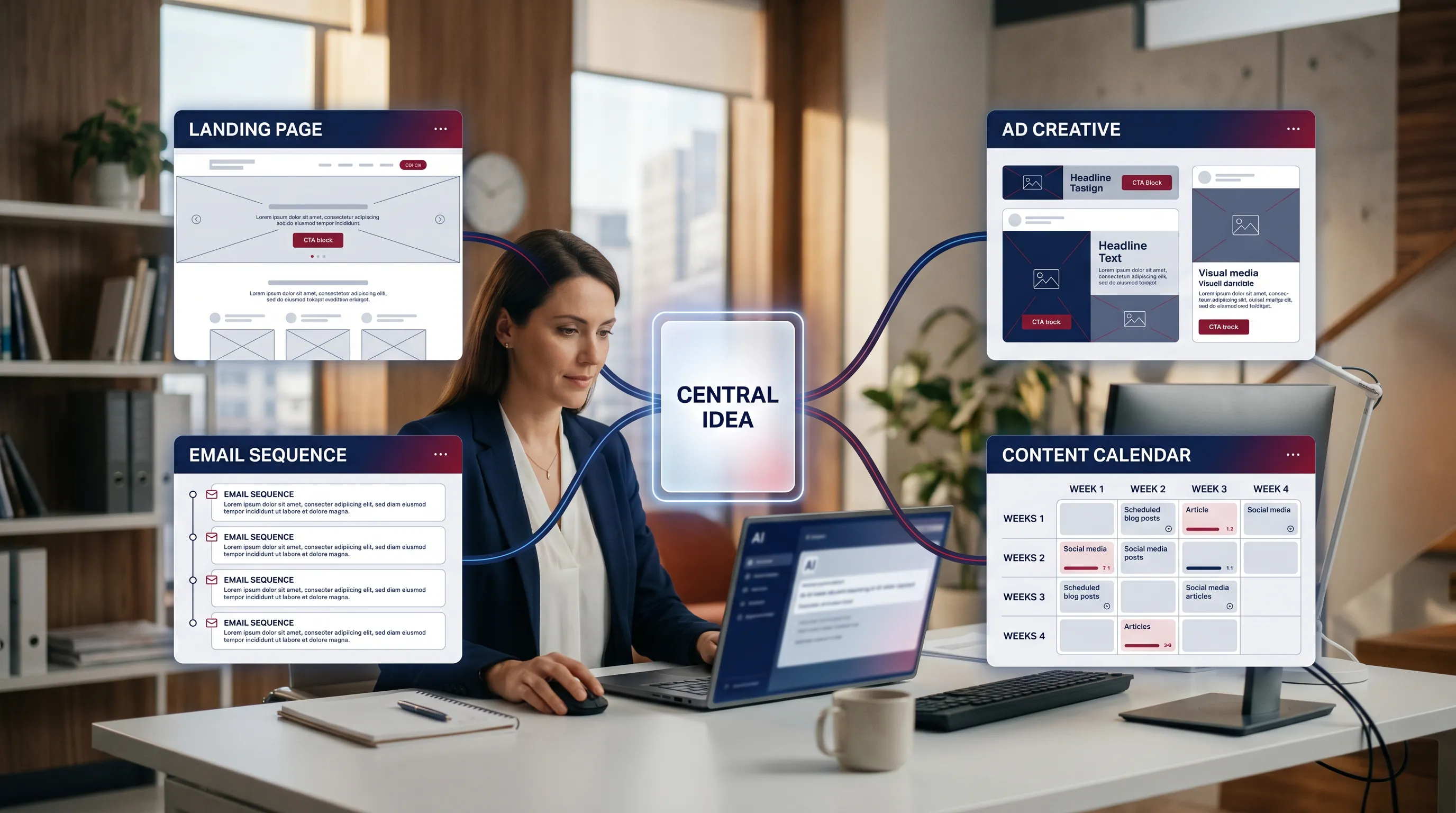
AI can help turn one business idea into a landing page, emails, ads, social posts, content, and follow-up by reusing the same core message across multiple assets. The workflow starts with the offer, audience, problem, proof, objections, and desired next step. Then AI helps create drafts for each campaign piece.
Why most campaign ideas never ship
Most campaign ideas don’t fail because they’re bad. They fail because the business gets stuck waiting for the page, the email, the ad, the post, the follow-up, the designer, the writer, the approval, or the next meeting. AI helps reduce the blank-page delay.
The advantage is speed. When a business can turn an idea into drafts quickly, the owner can judge the idea while the opportunity is still warm.
Step 1: Define the campaign spine
The campaign spine is the simple message that holds everything together. Before asking AI to write anything, define the audience, problem, offer, proof, objection, and next step.
- Audience: who’s this for?
- Problem: what pain or desire makes them care?
- Offer: what are you inviting them to do?
- Proof: why should they believe you?
- Objection: what might stop them?
- Next step: call, book, register, request, buy, or reply?
Step 2: Ask AI for the campaign architecture
Don’t start by asking AI for a Facebook ad. Ask for the campaign architecture first. That means the main angle, supporting points, page sections, email sequence, ad angles, social themes, and follow-up plan.
Step 3: Build the landing page draft
A landing page should make one next step feel obvious. AI can help draft the headline, problem section, benefit bullets, proof section, FAQ, guarantee language, and call to action. The business still needs to add real proof and remove any claims that aren’t true.
Step 4: Create the email sequence
The email sequence shouldn’t simply repeat the landing page. Each email should do a job: explain the problem, show the opportunity, answer an objection, provide proof, and invite action.
- Email 1: announce the offer and why it matters now.
- Email 2: explain the problem or missed opportunity.
- Email 3: show proof, example, or practical scenario.
- Email 4: answer objections.
- Email 5: make the direct invitation.
Step 5: Create ad and social angles
AI can create multiple ad and social angles from the same offer. Some angles can focus on pain, some on speed, some on proof, some on curiosity, and some on urgency. This gives the business options instead of betting everything on one weak line.
Step 6: Create follow-up for non-buyers
Many people don’t act the first time they see an offer. AI can help draft follow-up for people who clicked, asked, registered, downloaded, requested a quote, or went quiet. Good follow-up is useful, specific, and respectful.
What does the one idea workflow look like end to end?
- Write one clear idea or offer.
- Define the audience and next step.
- Ask AI for a campaign architecture.
- Draft the landing page.
- Draft the email sequence.
- Draft ad and social angles.
- Draft follow-up messages.
- Review, edit, and publish only what’s accurate.
How long should this whole workflow take?
An afternoon for the first version of everything. Not a finished campaign, a complete rough one: the page, the sequence, the ad angles, the follow-up, all existing in draft and all pointing at the same offer.
That is the actual shift. The old constraint was that each piece had to be commissioned, waited on, and assembled, so campaigns took weeks and most died in the gap. When the first version of the whole thing exists by the end of the day, the work becomes editing rather than starting, and editing is a job people finish.
What still needs a human in this workflow?
The spine and the standard. Deciding what the offer is, who it is for, and why anyone should care is the campaign. Get that wrong and AI will produce a fast, coherent, well-structured campaign for a bad offer.
The other human part is knowing when a draft is good enough to ship. AI will happily produce version twelve. Judging that version three was already better than what you had before, and sending it, is the skill that actually determines whether any of this speed turns into results.
Does this work for a small offer?
It works better for small offers, because small offers are the ones that never justified the effort before. A workshop, a seasonal promotion, a single service you want to test: none of those were worth three weeks of campaign building, so they stayed ideas.
When the whole campaign costs an afternoon, the maths changes. You can test the small thing, see whether anyone wants it, and either build on it or drop it without having spent anything you regret. That optionality is worth more to most businesses than the time saved on any single campaign.
What breaks when you run this workflow badly?
Two things, and both are predictable. The first is skipping the spine. If you start at the landing page because that is the fun part, every downstream piece inherits whatever the page happened to say, and the campaign ends up arguing with itself: the ad promises one thing, the emails another.
The second is treating the first draft as the deliverable. AI produces something coherent immediately, and coherent is not the same as right. The page will be well structured and generic unless you feed it the specifics only you have: the objection you actually hear, the customer language, the reason someone chose you over the cheaper option.
Both failures share a cause, which is letting speed set the order of the work. The sequence exists because each step feeds the next. Run it out of order and you get a fast campaign nobody responds to, which is worse than a slow one because you will do it again next month.
Where can you see this workflow built live?
At Winning With AI, you can watch one rough direction become usable business assets live: pages, emails, ads, content, follow-up, prompts, and workflows. That’s often the moment AI stops feeling like theory.
After the campaign assets are drafted, strengthen the sales handoff with AI sales scripts for calls and follow-up and make the content easier for answer engines to use with an AI answer engine optimization plan. The Winning With AI curriculum connects campaign creation to the rest of the business.
Find A Winning With AI Seminar
What else do people ask about this campaign workflow?
Can I really build a whole campaign in one afternoon?
The drafts, yes. A landing page, an email sequence, ad angles, and social posts from one clear idea is an afternoon's work with AI doing the first version of each. What still takes normal time is the deciding: what the offer is, who it is for, and what you are prepared to promise.
What do I need before I start the workflow?
One offer, one audience, and one promise you can defend. Those three are the campaign spine, and skipping them is why most AI-built campaigns read as competent and convert as nothing. AI can write in any direction you point it, which is exactly why the pointing has to be done first.
Should each channel get its own version of the copy?
Yes, and this is where the workflow pays off. The same idea has to sound different in a landing page headline, an email subject line, and an ad, because the reader's state of mind is different in each. Producing five real variations by hand is slow, which is why most campaigns ship with one.
How much editing does AI campaign copy actually need?
Expect to rewrite the opening lines and keep most of the structure. AI is reliably good at the shape of a page or a sequence and reliably generic in the first two sentences of anything. Editing in that order, structure kept and openings replaced, is faster than starting from a blank page.
What goes wrong when this workflow is run badly?
Somebody skips the spine, generates everything at once, and ships a campaign where the landing page promises one thing and the emails promise another. The check is simple: read the ad, the page, and the first email in a row. If the promise changes between them, the campaign has no chance.